Why Feedback Fails — And What Actually Changes Behavior
Most HR professionals already know feedback doesn’t reliably work. Fewer know why. Even fewer know what to do instead.
The Feedback Fallacy
Buckingham and Goodall made that case clearly in 2019 — and they were right. Correction activates the threat system. Learning happens in the opposite state. But there is a layer beneath it that even that argument doesn’t reach. Even when the conversation is positive, strengths-based, and perfectly delivered — the behavior it addresses has already happened. That is not a delivery problem. It is a structural one.
You have had the conversation. Probably more than once with the same person.
They nod. They understand. They even agree. And two weeks later, the behavior is the same.
Research by Kluger and DeNisi found that in roughly one-third of cases, feedback actively makes performance worse. In another third, it does nothing. Only in the remaining third does it improve anything — and even then, only under specific conditions.
Why Feedback Fails: Awareness Always Arrives Too Late
Even when feedback lands perfectly — no threat response, full understanding, genuine motivation to change — it still faces a structural problem that goes deeper than delivery, tone, or timing of the conversation.
Behavior is faster than awareness.
Natural talent patterns activate in milliseconds. They are driven by deeply wired neural patterns, not conscious intention. Neurological research shows behavioral patterns activate 300–500 milliseconds before conscious awareness registers the action (Libet et al., 1983). By the time awareness kicks in, the behavior has already happened.
Feedback addresses the wrong level. Not because it is delivered poorly — but because it enters the system too late.
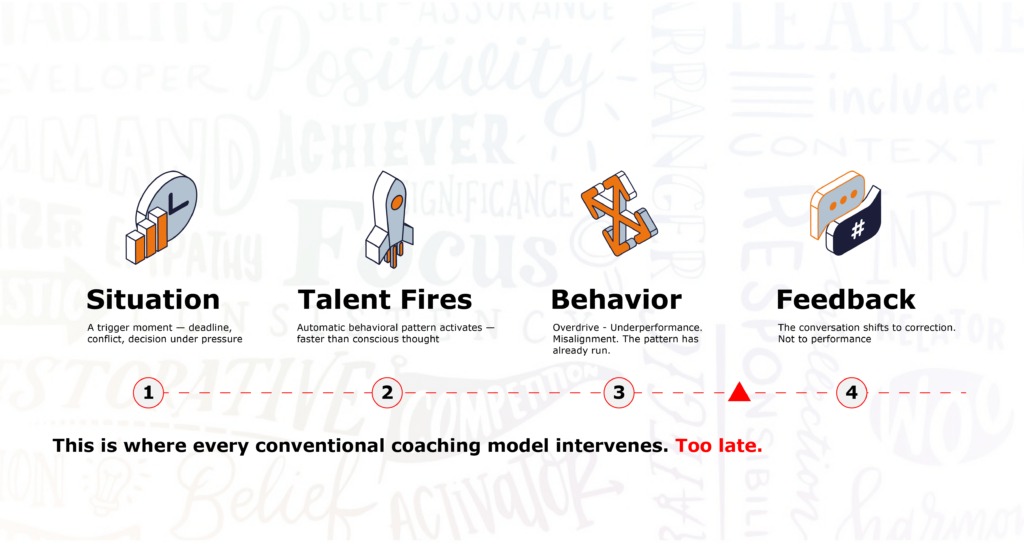
There are two moments where regulation can actually occur: before a situation activates a pattern (Pre-Regulation), and during the behavior itself (In-the-Moment Regulation). Most coaching targets neither. It targets the aftermath — which is structurally too late to change what happened, and often too early to change what comes next.
The CliftonStrengths Gap
Many HR managers and team leaders have invested in CliftonStrengths, expecting that awareness of strengths would translate into stronger performance. The team knows their profile. And yet performance issues persist.
This is not because CliftonStrengths is wrong. It is because awareness of your talent profile is not the same as being able to regulate how those talents activate.
A team member with high Activator knows they jump ahead. But in the next meeting, under pressure, they jump ahead anyway. Awareness did not prevent the behavior. It just gave them better words to describe it afterward.
What Talent Regulation™ Is
Talent Regulation™ is the ability to align how your natural talents activate with what the situation requires — before your automatic response takes over. It is the functional layer between talent identification and behavioral performance.
| Conventional approach | Talent Regulation™ | |
|---|---|---|
| Starting point | Behavior — already happened | Situation — before it activates |
| Intervention | Feedback, reflection, correction | Pre-alignment with situational demand |
| Timing | After the pattern has run | Before the automatic response takes over |
| Mechanism | Awareness → intention → (hoped-for) change | Regulation → Talent → Behavior → Result |
| What changes | Understanding of what went wrong | How the pattern activates next time |
What HR Managers Can Do Differently
1. Stop treating performance as a behavior problem. It is a regulation problem.
Feedback, performance reviews, and coaching conversations all target the same layer: awareness. But if behavior activates before awareness, targeting awareness will keep producing the same results. The diagnostic question shifts from “what did this person do wrong?” to “at what point does their talent pattern work against them — and why?” That shift alone changes the entire conversation — from correction to performance.
2. Build Talent Regulation capacity, not feedback culture.
The goal is not better feedback. The goal is building an employee’s ability to self-regulate how their talents activate — before behavior unfolds. That is a structural investment, not a conversation.
Feedback depends on an external trigger — a manager, a coach, a review cycle. The impulse for change comes from outside. That makes every improvement conditional on someone else initiating it. Talent Regulation™ works differently: the capacity to self-regulate lives inside the person. The motivation comes from alignment with their own natural wiring, not from correction by someone else. That is what makes it durable. Not because the person is more disciplined — but because the drive is intrinsic, not imposed.
3. Use CliftonStrengths as a regulation tool, not a profile.
A strengths profile tells you what someone is naturally wired to do. Talent Regulation™ tells you how that wiring activates under pressure — and what it takes to modulate it. The shift: from “this person has high Activator” to “what conditions make this person’s Activator work for them instead of against them?”
Frequently Asked Questions
Why does feedback fail to change behavior?
Feedback addresses awareness. But behavior activates faster than awareness — neurological research shows behavioral patterns activate 300–500 milliseconds before conscious awareness registers the action (Libet et al., 1983). By the time an employee processes feedback and forms an intention to act differently, the next behavioral moment has already passed. This is not a motivation problem. It is a timing problem.
What is Talent Regulation™?
Talent Regulation™ is the capacity to regulate in advance how your natural talents activate in a specific situation — so that behavior is shaped before the automatic response takes over. It is the missing layer between CliftonStrengths awareness and actual performance change.
How can a team leader address performance without repeating the same conversation?
Stop targeting awareness after the fact. Start building the capacity for pre-alignment — preparing how talent patterns will activate before the situation triggers them. That is what breaks the repetition. For the conceptual foundation, see What Is Talent Regulation™?
What is the difference between talent awareness and talent regulation?
Talent awareness is recognizing your patterns after they occur. Talent Regulation™ is the ability to shape how those patterns activate before they occur — through preparation, not reflection. Awareness is a starting point. Regulation is where performance actually changes.
Does CliftonStrengths improve performance?
CliftonStrengths improves self-awareness and team understanding. But awareness alone does not change behavior. Performance changes when people can regulate how their talents activate in advance — not just recognize them after the fact.
Ready to go beyond awareness?
The Self-Coaching Academy helps professionals and team leaders build Talent Regulation — the capacity to perform in the moment, not just understand themselves in retrospect.